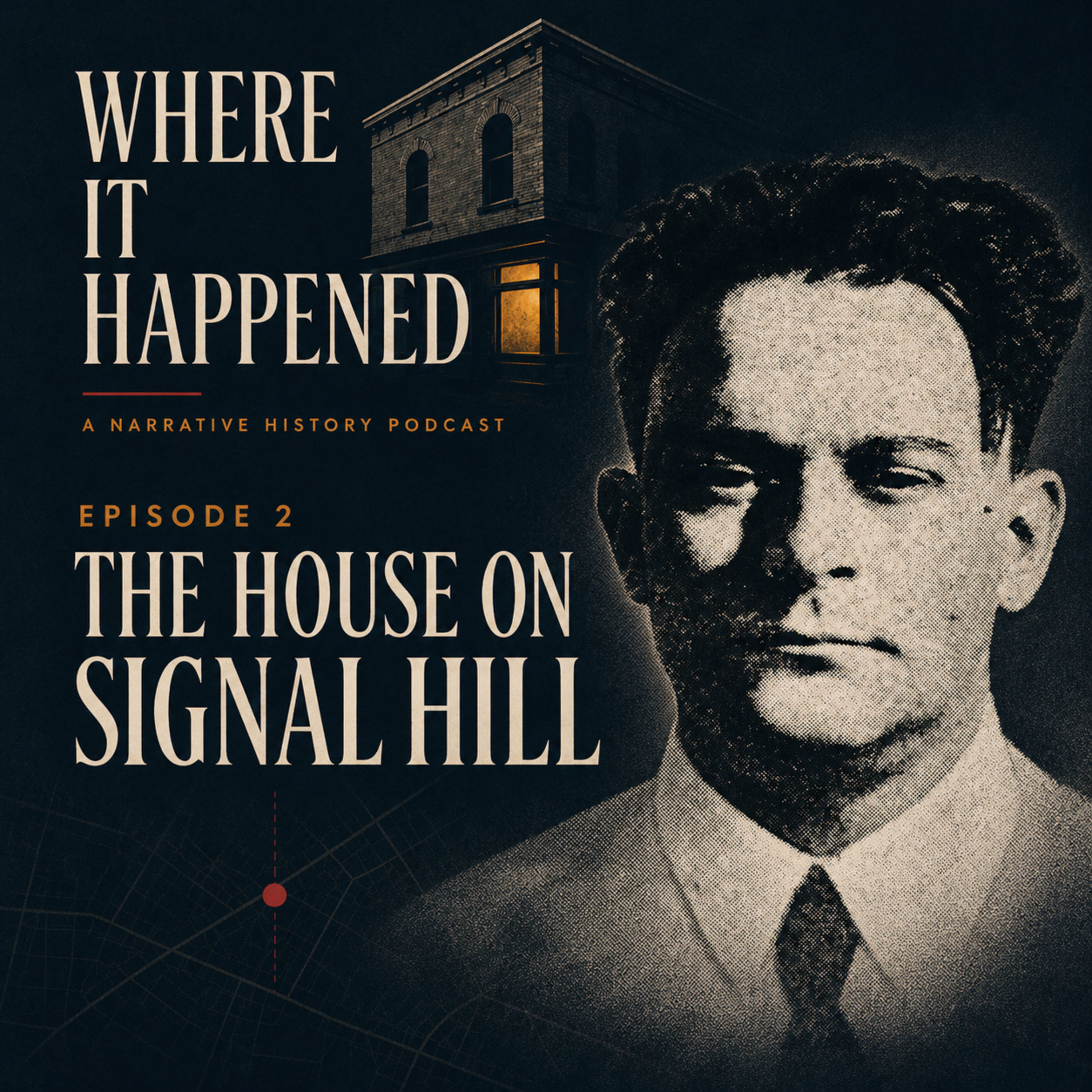
The House on Signal Hill
On December 8, 1934, sheriff's deputies raided a house in the quiet residential neighborhood of Signal Hill, Illinois, just across the Mississippi River from St. Louis.
Inside was a man the newspapers identified as James Hickey, an alleged associate of the notorious Shelton gang. Contemporary newspaper accounts reported that Hickey was killed that afternoon, two women were taken to jail, and authorities claimed they had uncovered a kidnapping plot.
But the newspaper accounts don't quite agree. And the sheriff's own statements raise questions about what happened that afternoon.
Nearly a century later, that house is still standing. And for host Jeff Allen, this particular piece of history hits a little closer to home.
Through historical newspaper accounts, photographs, government records and original audio recordings, we revisit a story that nearly disappeared with the people who lived it.
PRODUCTION CREDITS
Written, recorded, hosted and produced by Jeff Allen. Research by Brittani Allen and Jeff Allen.
THEME MUSIC
"What'll I Do" (1924) — Paul Whiteman and His Orchestra. Written by Irving Berlin. Source: Library of Congress, National Jukebox.
FEATURED HISTORICAL AUDIO
"Santa Claus Is Comin' to Town" (1934) — Harry Reser and His Orchestra, featuring Tom Stacks. Listen to the recording.
"Winter Wonderland" (1934) — Richard Himber and His Ritz-Carlton Orchestra, featuring Joey Nash. Source and recording.
1940 Major League Baseball All-Star Game — France Laux calling Max West's home run on CBS from Sportsman's Park in St. Louis. Source: RadioEchoes.
"Throw Me in the Alley" (1934) — Peetie Wheatstraw and His Blue Blowers. Source: Big Road Blues.
ADDITIONAL MUSIC
"Nights in the Woods" (1923) — David H. Silverman and His Orchestra. Listen to the recording.
"Bring Back That Old-Fashioned Waltz" (1924) — Jack Chapman and His Drake Hotel Orchestra. Listen to the recording.
"I'll See You in My Dreams" (1924) — Isham Jones with Ray Miller's Orchestra. Source: Wikimedia Commons.
HISTORICAL SOURCES
Research includes contemporary reporting from the Belleville Daily Advocate, Belleville Daily News-Democrat, St. Louis Star-Times, St. Louis Post-Dispatch and Taylorville Daily Breeze Courier, along with historical photographs, death certificates, marriage records and cemetery documentation.
ARCHIVAL AUDIO AND FAIR USE
This episode contains brief excerpts of historical sound recordings and radio broadcasts for the purposes of historical reporting, cultural commentary and education. These excerpts are presented within their historical context and are intended to constitute fair use under Section 107 of the United States Copyright Act.
Historical recordings are credited to their respective performers and source collections. All applicable rights remain with their respective rights holders.
CORRECTIONS AND CLARIFICATIONS
Following the episode's initial publication, several historical details were corrected in the narration. NBC's Let's Dance premiered on December 1, 1934. The contractor mentioned in the episode was George Locke Tarlton, and his daughter was Betty Jane Tarlton, who was 11 years old at the time. The published audio has been updated to reflect these corrections.
ABOUT WHERE IT HAPPENED
Where It Happened is an independently produced narrative history podcast exploring the remarkable, forgotten and sometimes unbelievable stories behind the places we know throughout the St. Louis region.
From familiar neighborhoods and historic buildings to forgotten crimes and extraordinary people, each episode explores a piece of our region's history through the places where it unfolded.
Learn more at whereithappenedpodcast.com.